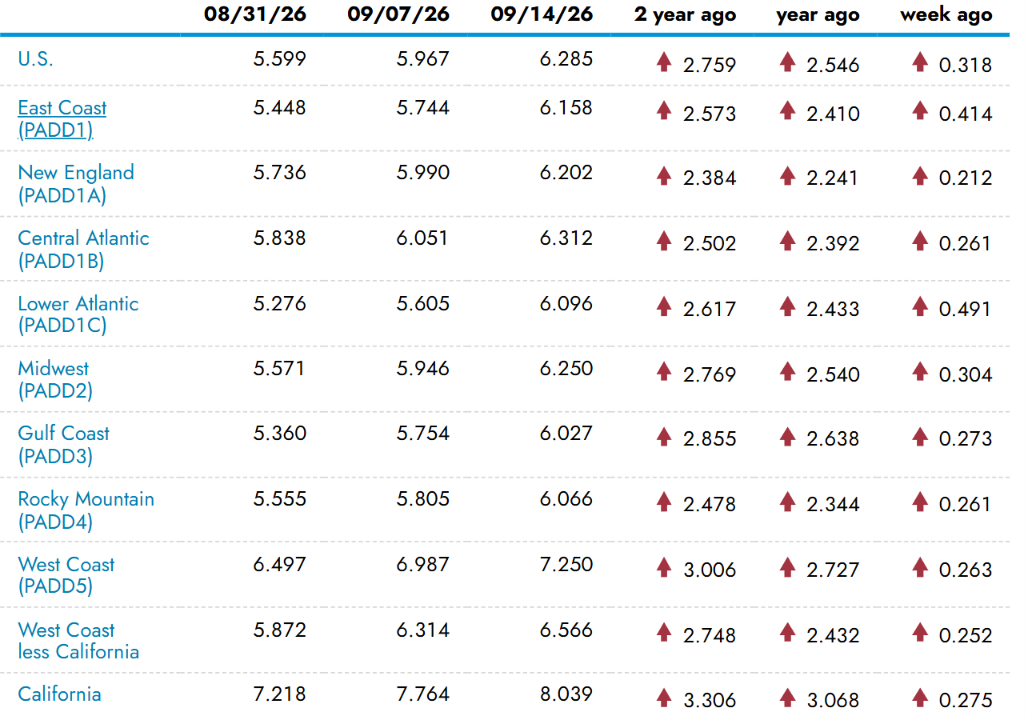
Source: EIA chart on diesel prices (USD/gallon) over the last 3 weeks, and the change from two years ago, a year ago, and a week ago.
diesel as a macrocosm of the conflict
The diesel situation is emerging as one of the most important economic consequences of the Iran War.
What initially appeared to be primarily a geopolitical and crude-oil supply problem is increasingly becoming a broader industrial problem. Diesel prices are rising sharply at the same time that several of the physical systems responsible for moving Middle Eastern oil are under pressure. Gas prices rising is one consequence of this, but that is merely the start of the problems. Diesel is one of the backbones of the modern economy. Trucking, agriculture, mining, construction, heavy equipment, freight, emergency services, manufacturing, rail support, warehousing, ports, and numerous supply chains depend on diesel either directly or indirectly. When diesel rises substantially in price, it moves through the economy. The diesel crisis is becoming a genuine risk event that spans across industrial and economic sectors.
According to the U.S. Energy Information Administration, the national average price for on-highway diesel reached $6.285 per gallon for the week of September 14, 2026. That represents an increase of 31.8 cents in only one week and more than $2.50 per gallon compared with a year earlier. Regional differences are even more severe. Diesel exceeded $7 per gallon on the West Coast and moved above $8 per gallon in California. These figures carry significance because diesel prices influence a much wider portion of the economy than the direct cost paid by drivers.
A trucking company facing sharply higher fuel costs has several choices, none of them especially attractive. It can absorb the cost and accept lower margins, reduce operations, or pass the cost forward through higher freight rates. The same logic applies to farms running tractors and harvest equipment, construction companies operating heavy machinery, mining operations, logistics companies, and manufacturers dependent on regular deliveries of raw materials and components. Eventually, much of that cost finds its way further downstream. This is one of the ways an energy shock can become an inflation shock.
The bottleneck Is Moving From Oil Supply Toward Oil Logistics
Another significant development is that which is happening to the infrastructure surrounding the commodity itself. The Strait of Hormuz has already been heavily restricted by the ongoing conflict. For decades, Hormuz has represented one of the most strategically important chokepoints in the global energy system. When access through the strait becomes constrained, producers require alternative export routes if they are going to maintain supply to international markets.
Saudi Arabia’s East-West Crude Oil Pipeline, also known as Petroline, became especially important under those conditions. The approximately 1,200-kilometer pipeline crosses Saudi Arabia from the eastern producing regions toward the Red Sea coast. During the current disruption, it had been transporting roughly 4 million to 5 million barrels per day toward western export facilities, allowing Saudi crude to bypass the Strait of Hormuz, which made the pipeline one of the most significant pipelines in the Middle East. It became a source of redundancy.
Saudi Arabia temporarily shut the pipeline after drone strikes damaged infrastructure along the route. Both Saudi and Iraqi authorities said the attack originated from Iraq, where Iran-aligned armed factions maintain considerable influence. Separate reporting based on Iraqi sources has attributed the operation to smaller breakaway cells associated with Iran-backed militia networks. Regardless of the exact command structure behind the attack, the strategic significance is substantial. A route designed to reduce dependence on one vulnerable chokepoint has itself become vulnerable.
Redundancy Is Being Removed
The aforementioned attack on redundance is where the present situation becomes more serious. Energy systems are not reliant on a single, port, refinery, shipping lane, or storage site. Resilience comes from having alternatives. Examples and situations of redundancy’s usefulness include:
If a strait becomes difficult to use, oil can sometimes be rerouted.
If one pipeline goes offline, storage can provide temporary support.
If one producer loses capacity, another may increase output
If one refinery is damaged, product can sometimes be imported from somewhere else.
The system works, or rather remains working, because there is redundancy. However, danger emerges when several alternatives become impaired simultaneously. The East-West Pipeline was one of the most important workarounds for restricted Gulf shipping. At the same time, Iran-backed Houthi forces have advanced around the Bab el-Mandeb Strait at the southern entrance to the Red Sea. Their movement toward Dhubab and Perim Island has increased concern about another globally important maritime chokepoint.
Hormuz connects Gulf oil producers to the wider ocean. Bab el-Mandeb connects the Red Sea and the Suez route to the Arabian Sea. If both corridors become unreliable while overland bypass infrastructure is also under attack. At that point, the whole energy network becomes much more challenging to traverse. The commodity may physically exist, but the ability to move that commodity from producer to buyer becomes constrained. The bottleneck, thus, becomes whether transported, loaded, insured, refined, and delivered to the places that need them.
The East-West Pipeline Attack Changes the Risk Calculation
The East-West Pipeline attack also raises a broader question about the direction of the war. Attacks on oil infrastructure create a different economic effect from conventional military operations. A strike against military equipment primarily affects battlefield capability. Meanwhile, a strike against a pipeline, refinery, tanker, terminal, or shipping corridor affects the economic system surrounding the battlefield. T raises insurance costs, changes refinery sources, creates uncertainty around future deliveries. This, in turn can force buyers into alternative markets and raise the price of replacement barrels, and it can affect countries thousands of miles away that have no direct involvement in the conflict.
Reuters reported on September 15 that Saudi oil loadings at Yanbu had been suspended and some late-September cargoes to Europe were being cancelled after the East-West Pipeline disruption. Brent crude moved above $109 per barrel and West Texas Intermediate above $106. Goldman Sachs also assessed that persistent disruption could increase the probability of Brent moving above $120 per barrel under a more severe supply-loss scenario. Meanwhile, some physical crude cargoes in Europe were already trading above $130 per barrel as buyers competed for alternative supplies. It is important to note that benchmark price can suggest one level of stress while actual buyers seeking immediate barrels may be paying significantly more, which means that some entities may be more impacted than others.
Diesel Is Where the Industrial Impact Becomes Visible
Crude oil prices attract most of the attention, but refined products are where many businesses directly experience the consequences. Diesel, being a refined oil product, occupies such a central position in freight and industrial activity. Raw materials may be transported to a factory by truck, heavy equipment may be used at the production site., components may arrive from multiple suppliers, and goods may then be moved to a warehouse, distribution center, retailer, or port. Diesel can appear at several stages of that process.
When the price of diesel rises sharply, the increase compounds through supply chains. This does not mean that a 20% increase in diesel automatically produces a 20% increase in the final price of a product. Transportation is only one part of the cost structure. However, it does mean that the cost base of the economy becomes less favorable. Businesses with pricing power can pass some of the increase forward. Businesses without pricing power may instead experience margin compression. Consumers face higher prices, businesses face weaker margins, or some combination of the two occurs.
The Inflation Problem Returns Through Energy
This is particularly important because the United States and other developed economies entered the current conflict without having completely escaped the inflationary damage of the early 2020s. Inflation had moderated, but the price level never returned to where it was before the original inflation shock. Lower inflation means prices are generally increasing more slowly. It does not mean that the previous increase disappears. Households therefore entered 2026 already facing higher costs for housing, insurance, food, services, transportation, and other necessities.
A new energy shock is being layered on top of those existing costs. This is why geopolitical events can have a larger economic effect when they occur in an already vulnerable cost environment. The problem is cumulative in the sense that higher prices can raise fuel prices, higher diesel prices can raise freight costs, higher freight costs can affect manufacturing and retail prices, higher energy costs can affect inflation expectations, higher inflation expectations can influence interest-rate expectations.
That can then affect borrowing, investment, housing, business expansion, and financial markets. The initial shock begins in a pipeline or shipping lane., then the effects can eventually reach monetary policy.
This Is Also a Manufacturing Problem
Manufacturing is particularly exposed because modern manufacturing depends on predictable input costs and reliable transportation. A factory does not operate independently from the energy system. It depends on electricity, transportation, raw materials, chemicals, packaging, industrial gases, machinery, and logistics. Petroleum products are also embedded directly in many manufactured goods. Plastics, synthetic materials, lubricants, chemicals, coatings, and numerous industrial feedstocks are tied to the broader petroleum complex.
A sustained oil shock therefore creates both direct and indirect pressure. Some manufacturers face higher energy costs, others face higher feedstock costs, and others face higher freight costs. Many may face all three This makes the current conflict relevant not only to energy companies, commodity traders, or governments. It is relevant to practically every organization that depends on physical goods.
A Broader Pattern in the 2020s
This event reflects a pattern that has repeatedly appeared throughout the decade. COVID exposed the fragility of global supply chains, the Ukraine War disrupted energy, grain, fertilizer, and commodity markets, Red Sea instability affected shipping routes, the Iran War has placed renewed pressure on Gulf production and transportation, the East-West Pipeline attack now demonstrates that even infrastructure specifically intended to provide an alternative to vulnerable maritime chokepoints can become a target.
The common theme throughout the decade is that highly optimized systems can become fragile when several points of failure occur simultaneously. Efficiency works extraordinarily well under normal conditions, but resilience becomes valuable when conditions stop being normal.
What Comes Next
The immediate question is whether Saudi Arabia can restore the East-West Pipeline quickly. U.S. Energy Secretary Chris Wright has expressed optimism that flows could resume within days, while other repair assessments cited by Reuters have ranged from very short timelines to several weeks. If the pipeline returns quickly, some of the immediate pressure may ease, but if the outage persists while Hormuz remains constrained and Bab el-Mandeb becomes more dangerous, the economic consequences could become considerably larger.
The more important long-term question is what this episode says about global industrial resilience. Countries will increasingly have to think about energy security not simply in terms of production volume, but in terms of routes, storage, refining capacity, reserve levels, domestic production, alternative infrastructure, and the ability to operate when one or more links in the system fail.
Businesses will have to think in similar terms. Supplier diversification, transportation exposure, fuel costs, inventory strategy, and regional sourcing become more important when geopolitical risk begins affecting physical infrastructure. Therefore, diesel is another indication that the physical architecture supporting the global economy is under increasing pressure.
Sources
U.S. Energy Information Administration (EIA): U.S. On-Highway Diesel Fuel Prices
https://www.eia.gov/petroleum/gasdiesel/
U.S. Energy Information Administration (EIA): U.S. Strategic Petroleum Reserve Stocks
https://www.eia.gov/dnav/pet/pet_stoc_wstk_dcu_nus_w.htm
U.S. Energy Information Administration (EIA): Short-Term Energy Outlook: Energy Security and Global Oil Transit
https://www.eia.gov/outlooks/steo/report/energysecurity/article.php
U.S. Energy Information Administration (EIA): World Oil Transit Chokepoints
https://www.eia.gov/international/content/analysis/special_topics/World_Oil_Transit_Chokepoints/
U.S. Energy Information Administration (EIA): Weekly Petroleum Status Report
https://www.eia.gov/petroleum/supply/weekly/
U.S. Department of Energy: Strategic Petroleum Reserve
https://www.energy.gov/ceser/strategic-petroleum-reserve
Reuters: Saudi East-West Pipeline attack and shutdown
https://www.reuters.com/business/energy/saudis-shut-down-oil-pipeline-houthis-tighten-grip-red-sea-shipping-2026-09-12/
Reuters: Bab el-Mandeb escalation and Houthi advances
https://www.reuters.com/world/middle-east/yemens-houthis-reach-strategic-island-mouth-vital-shipping-lane-2026-09-11/
Reuters: Oil prices and market reaction to Middle East escalation
https://www.reuters.com/business/energy/oil-prices-rise-saudi-pipeline-outage-fresh-attacks-raise-supply-concerns-2026-09-15/
Yahoo Finance: DOE/EIA diesel-price coverage
https://finance.yahoo.com/energy/articles/doe-eia-price-record-diesel-134155873.html
